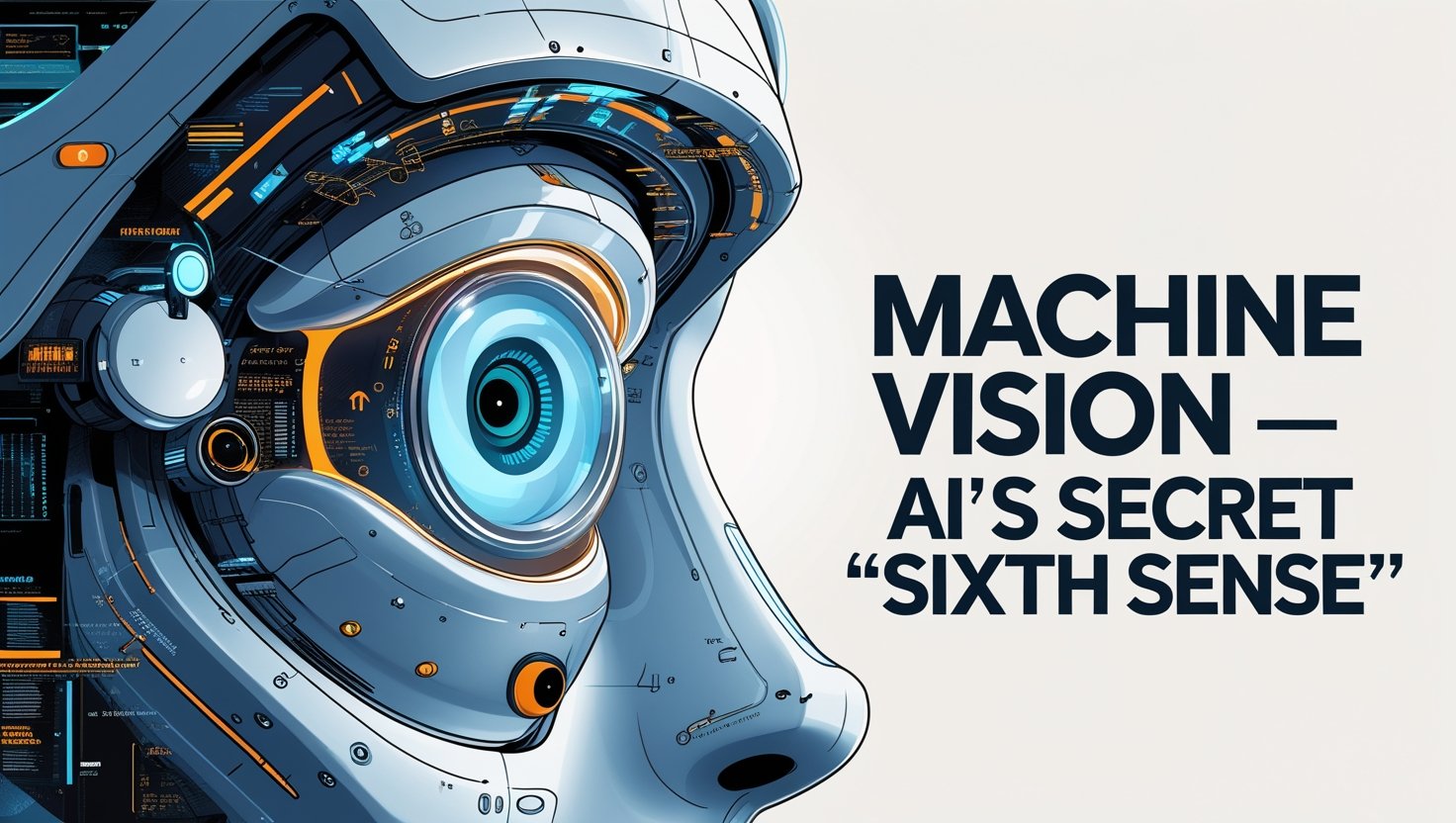
Imagine a world where machines not only process images but feel the scene around them, that’s the magic behind Machine Vision, AI’s secret Sixth Sense. When algorithms learn to interpret pixels like humans do sensory signals, applications explode, from safeguarding factories to empowering autonomous vehicles. In this exploration, we’ll unpack how computer vision gives machines a form of perception beyond our traditional five senses, reveal the breakthroughs fueling this transformation, and spotlight the unique challenges and ethical questions that come with granting machines sight. Strap in for a deep dive into the unseen world where AI learns not just to see, but to understand.
How Machine Vision Deciphers Visual Data:
At its core, Machine Vision involves capturing and analyzing images to extract meaningful information in real time. Cameras, ranging from tiny sensors on smartphones to industrial-grade lenses, feed streams of data into AI models trained to spot patterns, objects, and anomalies.
Once an image arrives, pre-processing steps like noise reduction and color calibration ensure consistency. Feature detection techniques, such as edge detection or corner mapping, highlight critical points, enabling the system to recognize shapes and textures. From there, classification algorithms tag each element: “pedestrian,” “defect,” or “ripe fruit,” depending on the task.
What sets modern machine vision apart is its ability to adapt. Instead of rigid rules, deep learning models fine-tune themselves by learning from thousands (or millions) of examples. This continuous feedback loop empowers systems to improve accuracy, adapt to new environments, and even predict what they’ll “see” next, mirroring the intuitive leaps of human vision.
The Neural Networks Powering Visual Intelligence:
Deep neural networks give AI its “sixth sense”, the ability to generalize visual patterns under diverse conditions. Key architectures include:
- Convolutional Neural Networks (CNNs)
- Extract hierarchical features via filters and pooling layers
- Residual Networks (ResNets)
- Overcome vanishing gradients to build ultra-deep models
- Transformer-based Vision Models
- Adapt self-attention mechanisms from NLP to image patches
- Generative Adversarial Networks (GANs)
- Synthesize realistic imagery for data augmentation
These networks don’t just recognize what’s visible; they infer what’s hidden, too. By training on vast datasets, they learn lighting invariances, gesture nuances, and even subtle texture cues. The result? Machine Vision systems that can track eye movements, read facial expressions, or identify microscopic defects, tasks once reserved for human specialists.
Applications That Turn Vision into Value:
When Machine Vision steps off the lab bench and into the real world, its impact is profound. Consider these game-changing use cases:
- Manufacturing Quality Control
- Instant defect detection on fast-moving production lines
- Autonomous Vehicles
- Real-time obstacle avoidance and traffic-sign recognition
- Healthcare Diagnostics
- Early detection of tumors from radiology scans
- Retail Analytics
- Foot-traffic heatmaps and shelf-stock monitoring
- Agriculture and Forestry
- Crop-health assessment via drone imagery
- Security and Surveillance
- Anomaly detection in public spaces
Each scenario leverages computer vision’s unmatched speed and consistency. Unlike human inspectors, AI doesn’t tire or lose focus; it scans thousands of frames per second, delivering pinpoint accuracy. That reliability translates to safer roads, fewer faulty products, and more personalized customer experiences, all powered by the quiet hum of cameras and processors.
Challenges in the Sightline:
Despite rapid advancements, Machine Vision isn’t flawless. Real-world environments introduce visual noise and unpredictability:
Low-light conditions can obscure vital details, while glare and reflections mislead feature detectors. Objects may be partially occluded, forcing models to guess what’s hidden. Variations in camera angle or resolution further complicate recognition.
To tackle these hurdles, engineers employ techniques like synthetic data generation, adaptive thresholding, and multi-sensor fusion, combining LiDAR, radar, or thermal imaging with standard cameras. By diversifying inputs, systems gain a holistic view, reducing false positives and bridging the gap between human intuition and algorithmic precision.
From Edge Devices to Cloud Vision:
Machine vision has evolved from bulky lab setups to nimble edge devices. Today’s smart cameras pack onboard processing power, running neural networks directly where data is captured. This shift minimizes latency, enhances privacy, and cuts bandwidth costs.
Meanwhile, cloud-based vision platforms host massive models that benefit from continual updates and pooled data from across industries. Developers can tap APIs to detect objects, extract text, or even generate image captions, all without managing infrastructure.
The most powerful solutions marry edge and cloud: initial inference happens locally for real-time performance, then complex analytics or model retraining takes place in the cloud. This hybrid approach ensures low-latency responses while continuously refining the Machine Vision “sixth sense.”
Balancing Privacy and Innovation:
As machines gain sight, safeguarding human rights becomes paramount. Key considerations include:
- Data Privacy
- Encrypting video streams and anonymizing identities
- Bias and Fairness
- Ensuring training datasets represent diverse demographics
- Transparency
- Clear policies on how vision data is used and stored
- Accountability
- Auditable logs for automated decisions based on imagery
- Consent
- Notifying individuals when and where cameras operate
By embedding ethics into design, from secure hardware modules to bias-detection audits, organizations can harness AI vision responsibly. Balancing innovation with respect for privacy ensures these systems augment human capability without compromising trust.
Emerging Trends in Machine Vision:
The horizon for Machine Vision brims with possibility. Self-supervised learning promises robust models trained on unlabeled video streams, drastically reducing annotation costs. Neuromorphic cameras, inspired by biological retinas, capture motion events rather than frames, slashing power consumption and data volumes.
In augmented reality, AI vision bridges the physical and digital, overlaying real-time insights on factory floors or guiding surgeons through intricate procedures. Meanwhile, 3D vision systems reconstruct environments in lifelike detail, enabling robots to manipulate fragile objects and autonomous platforms to navigate complex terrains.
As these technologies mature, Machine Vision will weave itself ever more seamlessly into daily life, empowering new levels of safety, efficiency, and human-machine collaboration.
Conclusion:
By granting machines a Sixth Sense, AI-driven Machine Vision reshapes industries and redefines possibility. From edge devices that make split-second safety calls to cloud platforms analyzing petabytes of imagery, computer vision delivers insights humans alone could never achieve. Yet with this power comes responsibility: ensuring privacy, fairness, and transparency will be critical as we entrust decisions to algorithms that “see.” As neural networks grow more sophisticated and sensors more capable, the line between human and machine perception will blur, opening doors to innovations we’ve only begun to imagine.
FAQs:
1. What exactly is Machine Vision?
Machine Vision is the use of cameras and AI models to interpret and process visual information automatically.
2. Why is Machine Vision called AI’s Sixth Sense?
Because it allows computers to perceive and understand visual data beyond the traditional five human senses.
3. What industries benefit most from Machine Vision?
Manufacturing, healthcare, automotive, agriculture, retail, and security gain significant value from vision systems.
4. Can Machine Vision work in low-light or noisy conditions?
Yes, techniques like multi-sensor fusion, adaptive thresholding, and synthetic data help maintain accuracy.
5. How do edge and cloud vision differ?
Edge vision processes data locally for speed, while cloud vision handles heavy analytics and model updates remotely.
6. What ethical concerns surround Machine Vision?
Data privacy, bias in datasets, transparency of usage, and consent for image capture are the primary concerns.
About the Author